Exhibition images
Click on each image to see the full resolution version.
Bostock’s Royal Italian Circus (1929)
© South Lanarkshire Libraries and Community Learning
Licensor www.scran.ac.uk
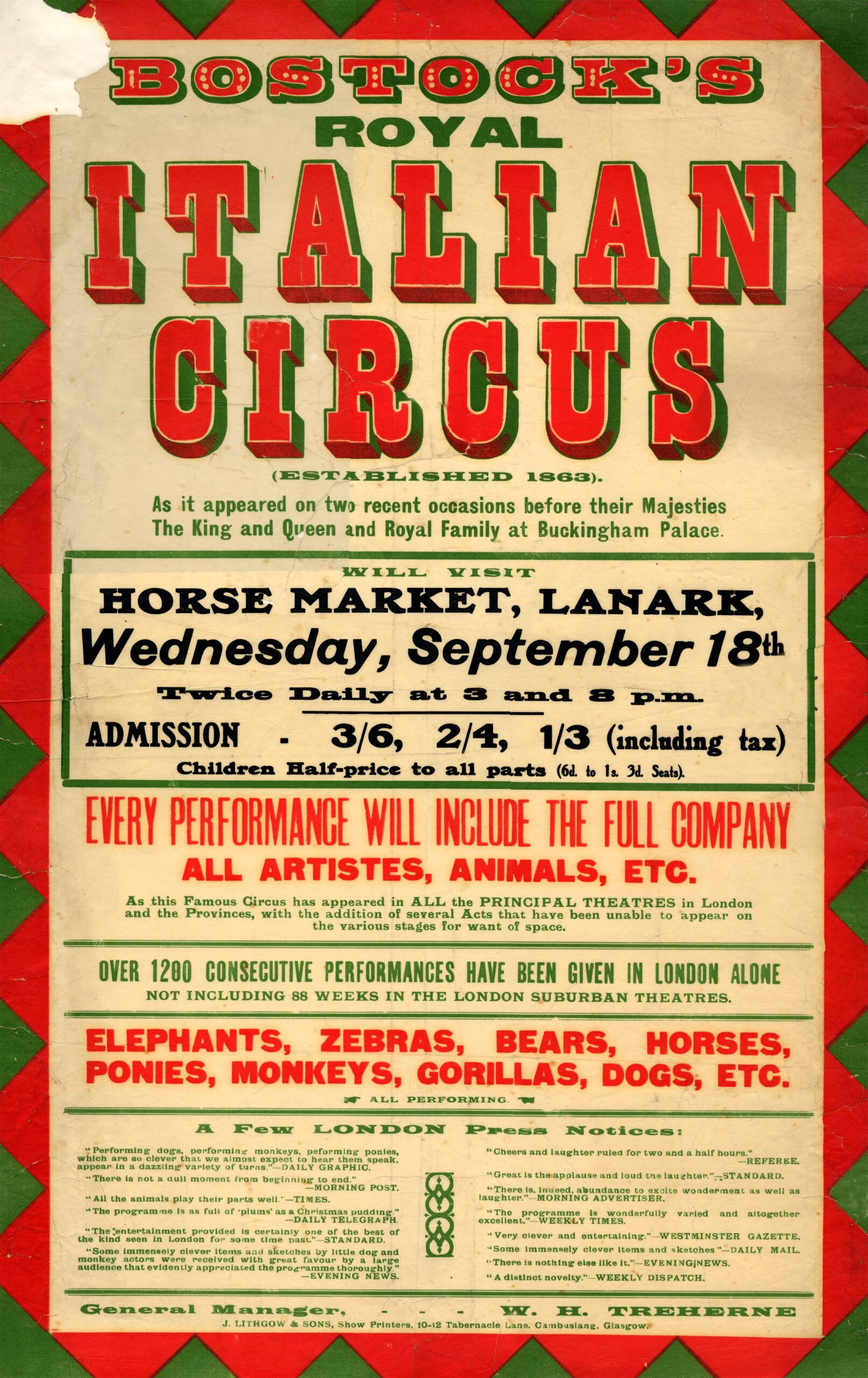
This poster announces the esteemed arrival of Bostock’s Royal Italian Circus to Lanark in 1929. Illustrated with vivid colours and adorned with elegant typography, the poster showcases Italy’s rich circus tradition, dating back to its Roman roots where performances featuring acrobats, jugglers, and equestrians were popular forms of entertainment in amphitheatres and public squares. Bostock’s Royal Italian Circus was part of the larger Bostock entertainment empire, which included various circus, menagerie, and fairground attractions. In 1899, Edward Henry Bostock, a member of the Bostock family entertainment dynasty, opened the Scottish Zoo and Variety Circus in Edinburgh, Scotland’s first ever zoo.
Maria Minchella, The Lanimer Queen (1907)
© South Lanarkshire Libraries
Licensor www.scran.ac.uk
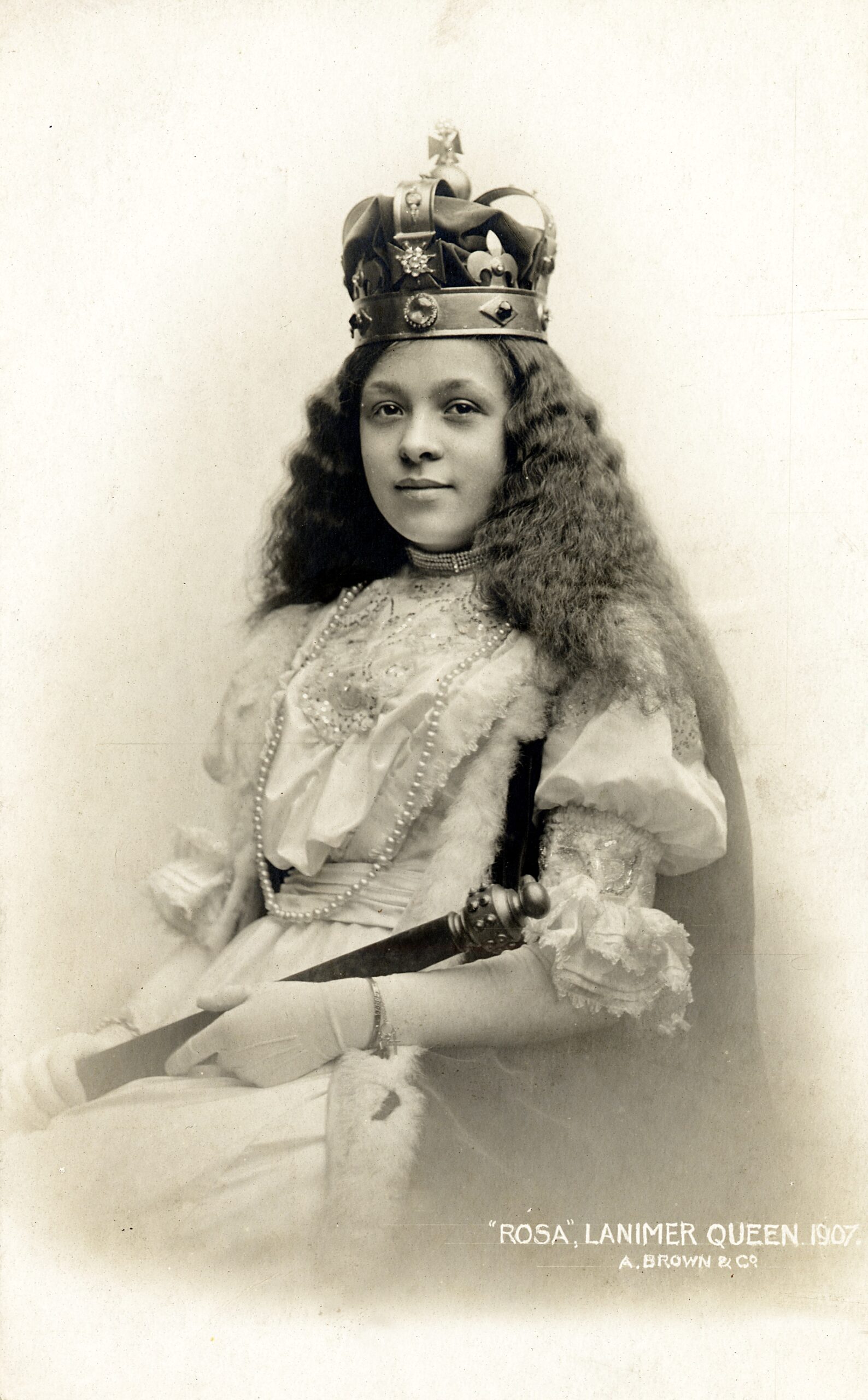
Maria Rosa Minchella poses majestically as Lanark’s Lanimar Queen of 1907. As part of the Lanimar week celebrations, Maria was chosen to reign as Lanimar Queen by her fellow pupils at St Mary’s school. The festival is one of Scotland’s oldest traditions, celebrating Lanark’s thousand-year-old status as a royal borough. The Minchella family, originally from Villa Latina, Lazio, owned one of the first Ice Cream and confectionary shops in Lanark and were among the first to own an automobile. Today, a stone bearing the initials SM of Maria’s father Steven Minchella, formally Stefano, stands outside Bannatyne Street where his shop was previously located.
Garibaldi panorama, Stirling (1863)
© Bob McCutcheon, The Bookshop, Stirling
Licensor www.scran.ac.uk

Pictured is a playbill for a Garibaldi panorama event in Stirling 1863. Panorama paintings were large circular artworks displayed in rotundas. Viewers stood in the centre and were surrounded by the painting, creating an immersive experience of different landscapes or historical scenes. Popular before cinema, they provided entertainment and education, often accompanied by narration or music. This event centred around the recounting of Garibaldi’s military campaigns in Italy and Sicily. Giuseppe Garibaldi (1807 – 1882), a popular military icon in Scotland, was known as the ‘Wallace of Italy’. There were even Scottish volunteers for his military campaigns. John McAdam (1806 – 1883) raised funds and soldiers for the Garibaldian army and managed to garner Garibaldi’s support for the promotion of the National Wallace Monument. The Garibaldi biscuit stands as a tribute to the impact of the Italian general on British popular culture.
Footballer Rolando Ugolini
© City of Edinburgh Council
Licensor www.scran.ac.uk

Pictured above is goalkeeper Rolando Ugolini also known as ‘The Cat’ or Ugo. Born in Lucca in 1924, Ugolini moved to Scotland at the age of three and grew up in Armadale, West Lothian, where he played for the local club, Armadale Thistle. After leaving school he worked in the family fish and chip shop before leaving at 18 to become a professional footballer. Rolando’s father Giacondo had moved to Armadale after the First World War, in 1920. However, during the Second World War, he was interned on the Isle of Man for a year as an ‘enemy alien’. Rolando and his mother were relocated to Cambuslang, Glasgow, where, too young to fight, he was ordered to do ‘war service’ at home while his brother Romeo served in the British Army, initially in the Black Watch.
Ugolini Saving the Ball
© City of Edinburgh council
Licensor www.scran.ac.uk
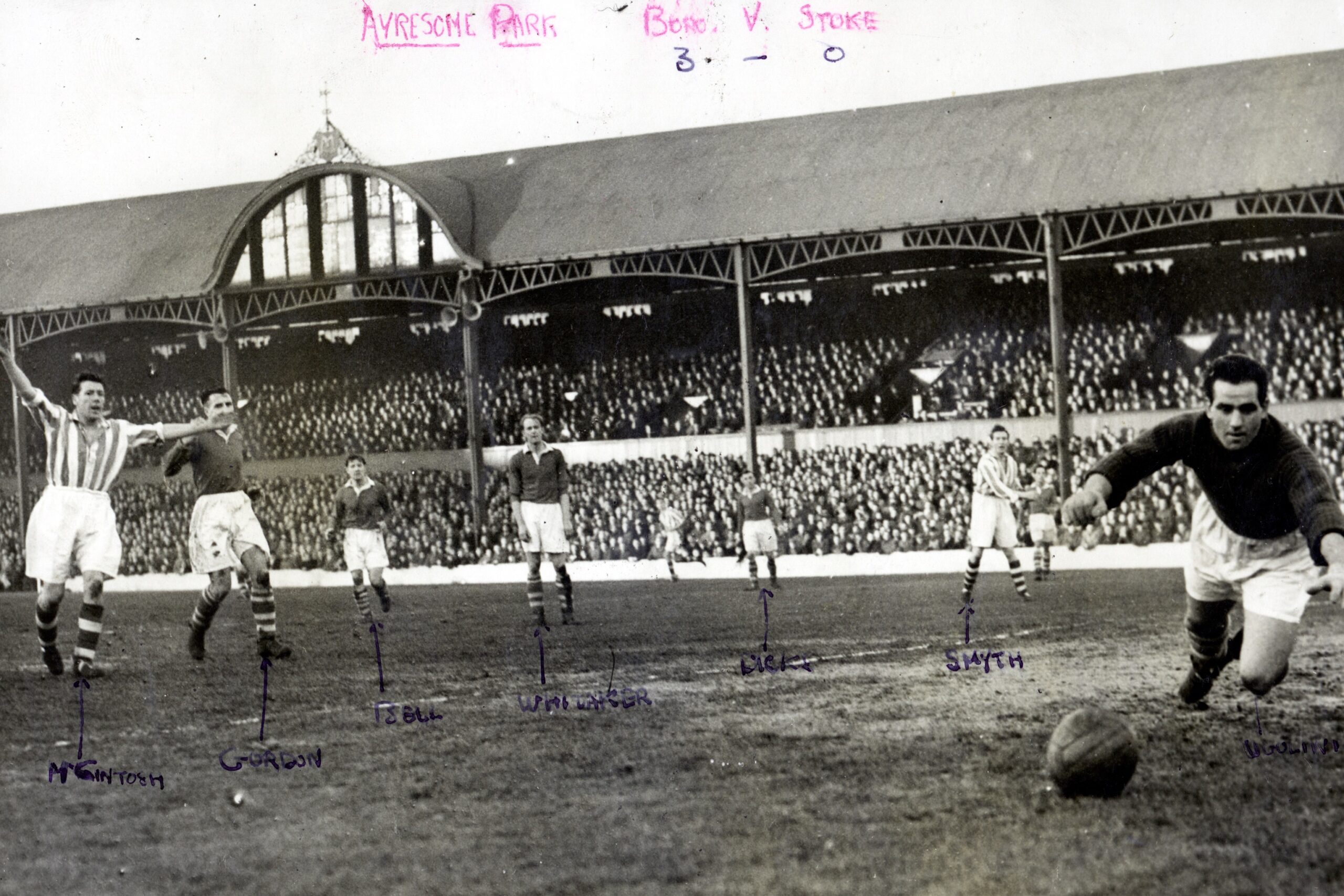
Pictured is Goalkeeper Ugolini saving the ball in a football game at Ayresome Park.
He began his football career with Armadale Thisle and after a trial at Hearts he eventually signed for Celtic in March 1944. He went on to play for Middlesbrough, Wrexham, Dundee Utd., ultimately retiring at Berwick Rangers. Joining Middlesborough in May 1948, Rolando Ugolini proved to be a big hit, playing 320 games for the club. His final appearance was at Celtic Park, playing for Dundee United on 10 December 1960. He went on to establish a career in the bookmaker industry, becoming the proprietor of three betting shops.
Togneri Ice Cream, Dunbar (1920)
© East Lothian Museums Service
Licensor www.scran.ac.uk

Pictured are a group of well-dressed people having their photograph taken while enjoying an ice cream beside Togneri’s Ice Cream Van in Dunbar in 1920. The Togneri family, originating from Barga in Tuscany, left an indelible mark on Dunbar’s culinary scene. They were the proprietors of the Lido Café, Billiard Hall and the Central Café, Dunbar’s first fish and chip shop. Joe Togneri started the motorbiking club of Dunbar, reflecting his deep ties to the community. With the outbreak of World War II and the perception of Scots Italians as ‘enemies within’, Joe Togneri was the sole brother among four to be interned. He was subsequently deported aboard the SS Arandora Star, the ship that fell victim to a German U-boat torpedo, claiming the life of Joe Togneri and 441 other Italians.
The Broughton Confectionary and Refreshment Saloon (1907)
© Scottish Life Archive, National Museums of Scotland
Licensor www.scran.ac.uk
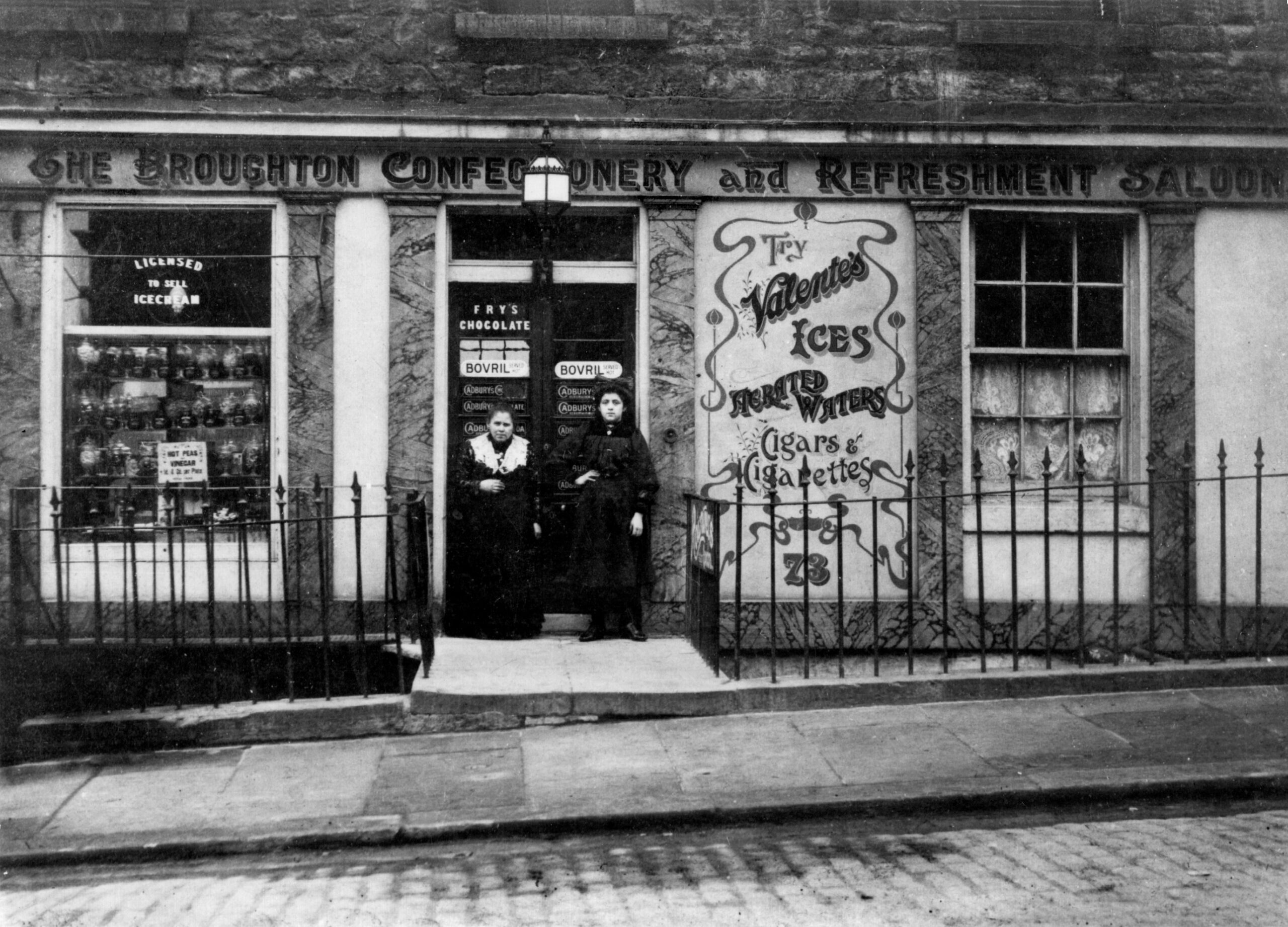
Two women stand proudly outside the Broughton confectionary shop in Edinburgh, 1907. Italian emigrants to Scotland during the late 19th and early 20th made up just less than 20 percent of the total influx of Italian immigrants to the United Kingdom during that period. Many Italians entered the culinary business, pioneering the establishment of Scottish ice cream parlours, fish and chips shops and, later, Italian restaurants, often adapting their recipes and traditions to Scottish tastes. The cafes transcended their primary functions of serving ice cream, food and hot drinks to become vital social hubs and meeting spots for communities across Scotland.
Artist Eduardo Paolozzi
© Hulton Getty
Licensor www.scran.ac.uk
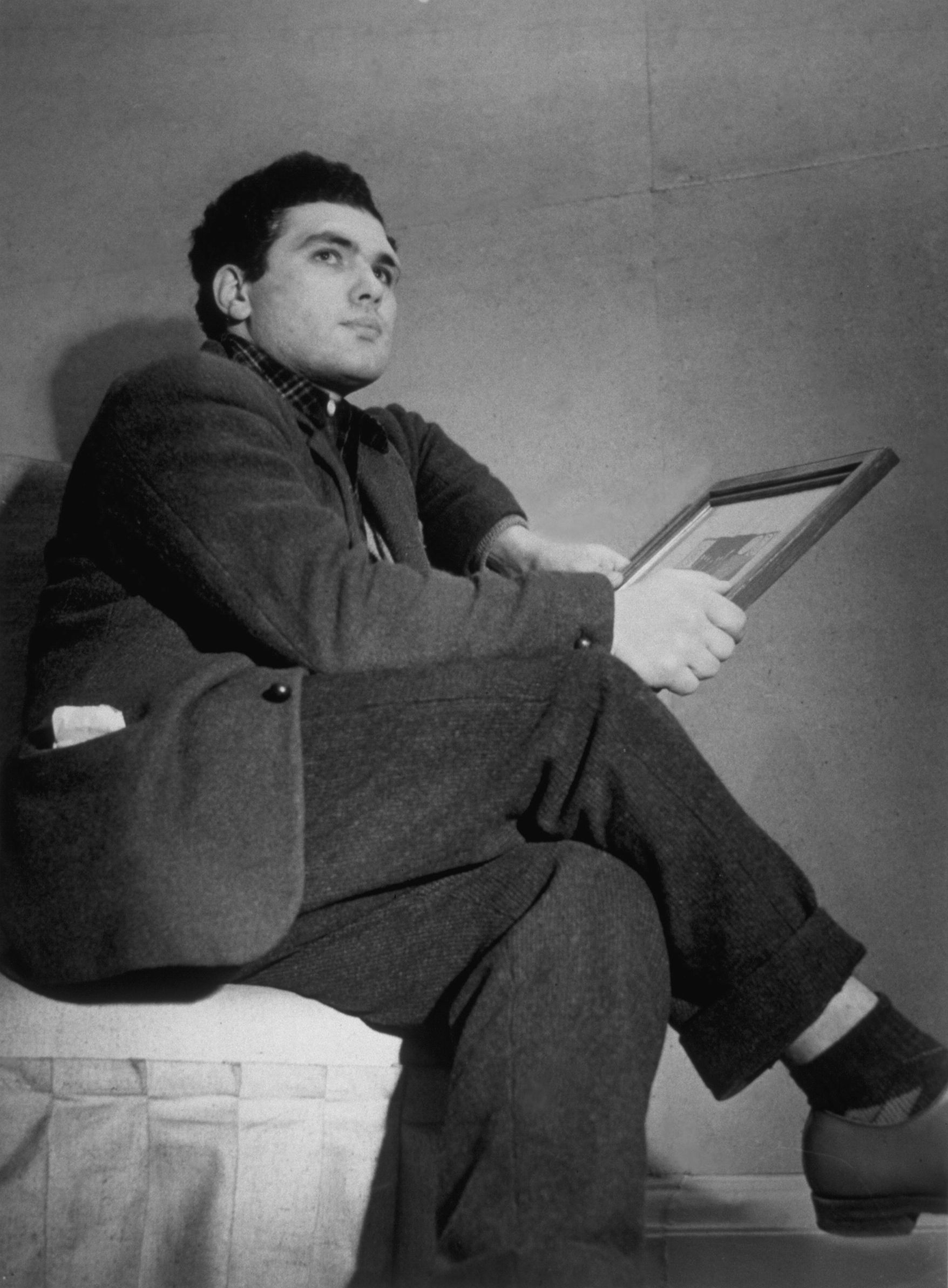
Artist Sir Eduardo Paolozzi (1924 – 2005) is photographed looking pensive. Paolozzi, born in Leith, Edinburgh to Italian parents from Viticuso, in Lazio, was a pioneering figure in the British pop art movement. Paolozzi’s father, grandfather, and uncle perished aboard the SS Arandora Star. A graduate of the Edinburgh College of Art and the Slade School in London, Paolozzi is renowned for his original pop-art collages and vibrant metal sculptures. Drawing inspiration from his upbringing in his parents’ ice cream shop, he found art in everyday objects such as cigarette packets, advertisements and magazines. Knighted and appointed the Queen’s Sculptor for Scotland, he contributed greatly to the UK’s public art landscape. His legacy is evident in iconic works such as the mosaic mural for Tottenham Court Road Underground station, the bronze sculpture of Newton at the British Library and the Manuscript of Monte Cassino in Picardy Place, Edinburgh.
Paolozzi had a close relationship with the University of St Andrews. He was awarded an honorary doctorate in 1994, and exhibitions of his work were held here in 1979 and again in 1998. He also donated some of his work to Museum Collections.
Barbara Grigor & Paolozzi sculpture (1989)
© The Scotsman Publications Ltd
Licensor www.scran.ac.uk

Pictured here is Barbara Grigor, Chair of the Scottish Sculpture Trust, carefully studying Eduardo Paolozzi’s ‘Model for the Concept of Newton’ at the Talbot Rice Gallery at Edinburgh University in 1989. Paolozzi’s sculpture, based on William Blake’s satirical print of Newton (1975), explores the interplay between art and science, a tension that fascinated the artist. He felt that art should be recognised beyond the conventional paradigm, citing the Science museum as a great source of inspiration for him. Similar sculptures can be found at prominent locations worldwide, including the British Library in London, at the Scottish National Gallery of Modern Art in Edinburgh and in Kowloon Park, Hong Kong.
Mannofield Tram Depot, Aberdeen (1905)
© Aberdeen City Council, Arts & Recreation department
Licensor www.scran.ac.uk
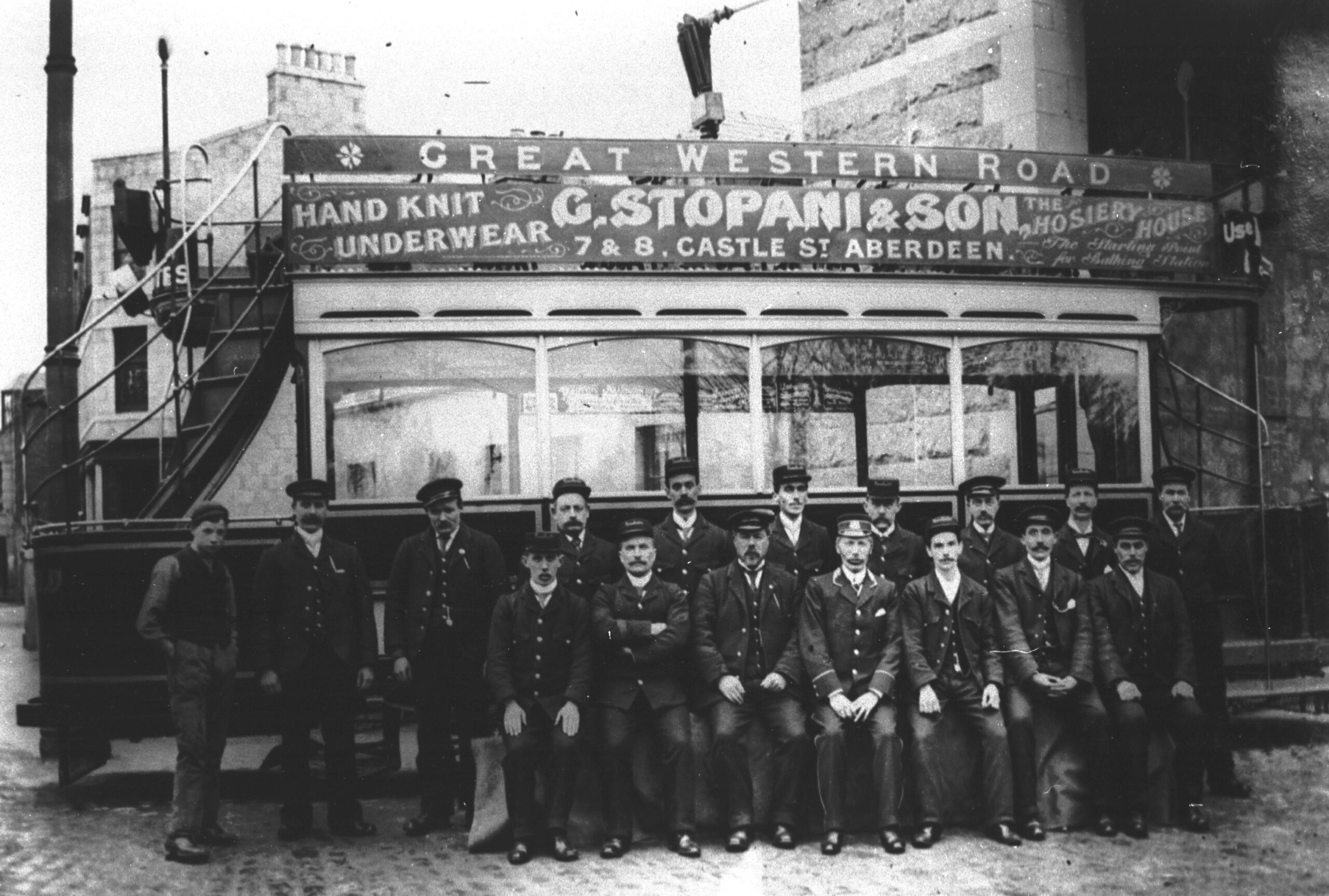
The photo likely depicts the crew overseeing the Deeside Route extension from Mannofield to Bieldside, alongside Great Western Road, a major thoroughfare in Aberdeen. They stand before a G. Stopani & Son’s advertisement, a clothing and hosiery house. The Hosiery House was actively involved in the local community, participating in charitable initiatives, sponsoring events, and supporting civic causes. The Stopani family cultivated strong relationships with customers and fellow merchants, contributing to the vibrant social and economic fabric of Aberdeen.
Bill from A. & J. Gonnella (1875)
© Dundee Central Library
Licensor www.scran.ac.uk
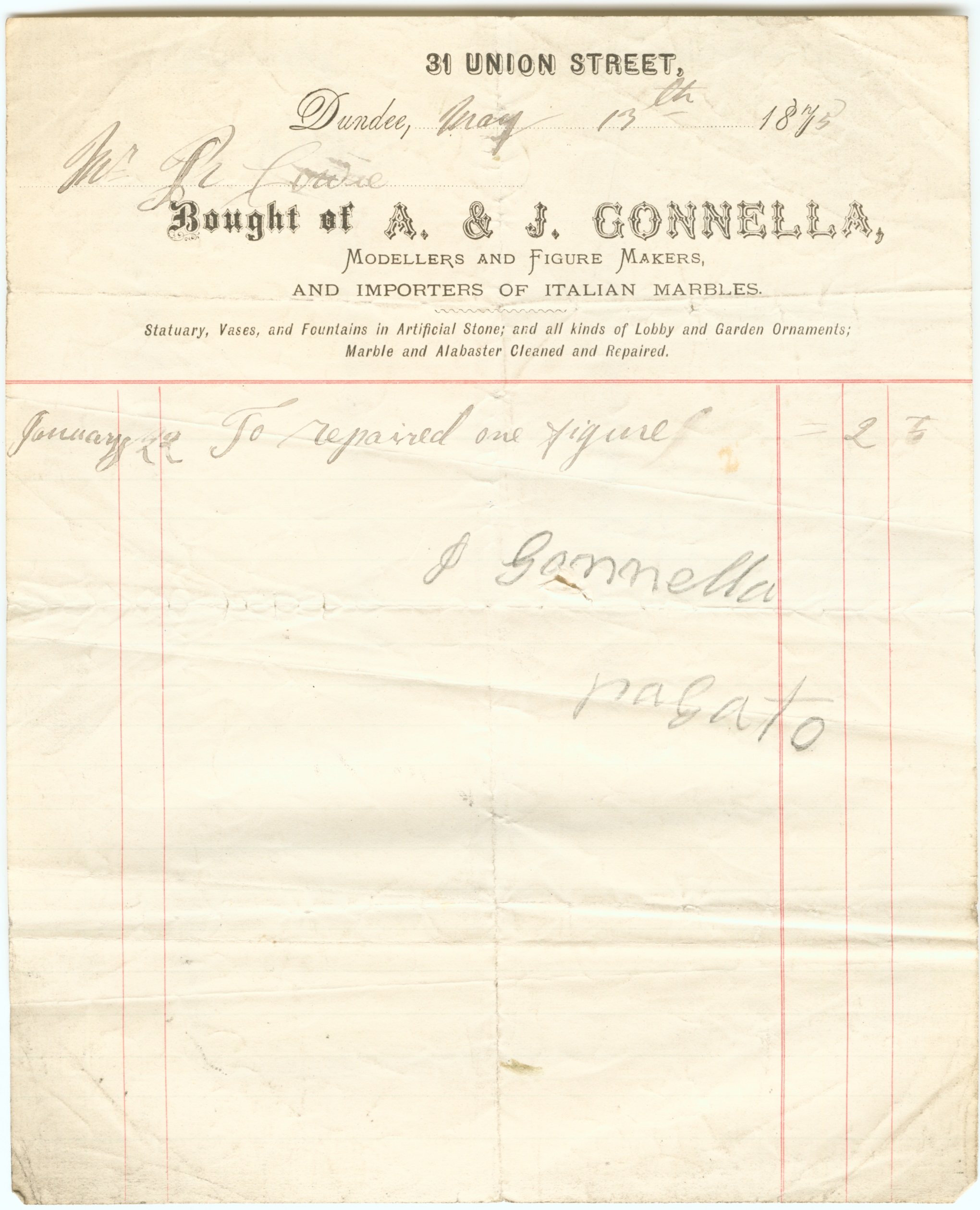
The bill, signed by Joseph Gonnella, marks payment for a figurine repair. Joseph, or Giuseppe, born in Barga, Tuscany, served as Italian consul of Dundee in 1909, as did other family members Francesco/Frank and Luigi/Louis. Most figurine and sculpture makers came from Barga, also known as ‘the most Scottish town in Italy’ due to the high number of residents that immigrated to Scotland. A. & J. Gonnella imported Italian Sculpture and marble. Italian marble, known for its quality, variety and beauty, was extensively used in prestigious buildings, an example is the Scottish National Portrait Gallery in Edinburgh, showcasing intricate marble work sourced from Italy.
Letterhead from Cooper & Co (1896)
© South Lanarkshire Council
Licensor www.scran.ac.uk

Cooper & Co.’s ornate letterhead showcases their legacy as leading wholesale tea merchants and grocers. Established by Thomas Bishop in 1871, it began as a single shop in Glasgow’s west end, gradually expanding into a prominent grocery chain with branches across Scotland and England, and warehouses in Glasgow, London, and Liverpool. Known for their high-quality produce, Cooper & Co. supplied premium tea, coffee and grocery items, alongside a range of imported Italian delicacies – hence the reference to ‘Italian warehousemen’. The provision of Italian goods may have been influenced by the concurrent rise in Italian-run culinary businesses and grocers. Enterprises like Bellando Brothers in Greenock or Valvona & Crolla in Edinburgh similarly expanded and diversified their operations, some opening multiple locations across Scotland, while others expanded into wholesale distribution, providing Italian produce to restaurants, delis, and retailers.